Uconn Insider Podcast Struggles Continue for Husky Men and the Big East Question
The Affects of Realignment on non-Power 5 Schools
By BigSnoop
Since the latest round of realignment and it's trickle down have had a chance to settle down, I thought it would be interesting to examine the effects on other schools and conferences. The initial conclusion for me is that schools that are in non-Power 5 conferences are being forced to make a hard choice. With dwindling resources from TV contracts and the loss of marquee programs, they have to decide where to focus: football or basketball (or both). Following is a breakdown of conferences, and a projected outlook for their future.
American Athletic Conference
The old Big East programs that remain in the AAC (Cincinnati, UConn, and South Florida) have been able to delay the financial hit from their reduced TV revenues because they have benefited from the NCAA basketball revenues left behind when the remaining Big East teams left. The problem is going to hit them soon, as the NCAA revenues are spread out over six years, and the money left behind is in year five.
From what we've seen so far, it appears USF is going all in for their football program. They've hired two high profile coaches since the split, and have greatly improved their standing. The basketball team is a wreck, and doesn't show signs of improving anytime soon. Cincinnati and UConn appear to be trying to succeed at both sports. Cincinnati has maintained their standing in basketball, but the football program has fallen on hard times. They invested money in stadium renovation, but it will be interesting to see what they do once their NCAA basketball shares shrink. UConn has struggled in basketball since their championship run in 2014, and the football team has suffered from mediocrity and lack of fan interest. They need better results soon, or I suspect the state of Connecticut may not be willing to keep pouring money into men's athletics.
Of the other AAC schools, Houston has been solid in both sports. They have lots of state money, plus a strong local recruiting base in both sports. Every other school has seen either one or both of their sports suffer in recent years. SMU and UCF have improved their basketball programs at the expense of football, while Temple and Memphis are the reverse. The other schools have had limited success or less in both sports.
Mountain West
No conference has fallen further since the latest realignment than the Mountain West. At the beginning of this decade, Boise St., TCU, Utah, and BYU were all top fifteen caliber football programs, with Colorado State, Nevada, and Air Force making appearances in the top 25. Now, TCU, BYU, and Utah are gone, and Boise St. is a fringe top 25 program. Additionally, the basketball conference was in the top three in RPI, and is now a one or two bid conference. Since the Mountain West, like the AAC, will not see an increase in TV revenues anytime soon, they seem to be willing to accept their basketball fate while still investing in football, as most of the schools have rabid fan bases.
Conference USA
Conference USA was well below Mountain West before realignment, and has suffered a proportional drop in prestige since. They lost Memphis, UCF, Tulsa, East Carolina, and Tulane to the AAC, and their top program now is probably Western Kentucky. The exit fees from the AAC schools end this year, and their TV contact pays $200,000 per team, which limits their opportunities for improvement. They at least get points for creativity, and they will be broadcasting games this year on Twitter.
Sun Belt and MAC
The Sun Belt has never been much of anything in basketball, and that hasn't changed. The odd thing is that their football conference is arguably better now, despite losing several programs to Conference USA. They appear to have focused completely in football, and the schools they added are in football-rich areas, like Georgia and Texas. I believe that the Sun Belt is better than Conference USA in football, and will get more TV revenue in their next contact (still not much, but better).
The MAC seems to live in their own bubble, and have teams that are content to compete in this conference. They've had very little turnover, with no teams coming or going in the realignment cycle, except Buffalo replacing UMass. This was a better fit for the league anyway.
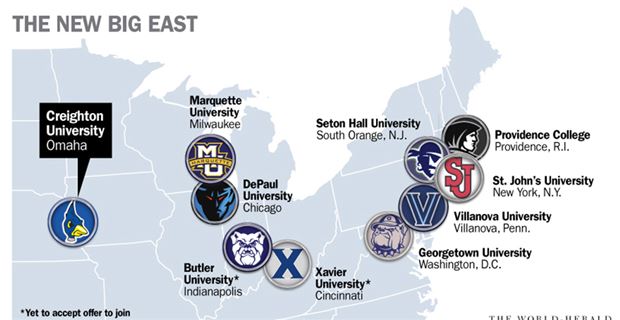
In addition to this, the Atlantic 10, Big East (non-football teams), Missouri Valley, and West Coast conferences were all above mid major level in basketball. The Big East basketball teams are stronger than ever as a group, and get two to three times the TV revenue than they received under their last contract. The new schools have fit in seamlessly, as if they were always in the league.
The West Coast conference gained BYU in basketball, and is expected to expand in the next year or two. The A-10 has been hurt by the loss of Butler and especially Xavier, but they still have a number of schools that can compete for a tournament bid on a regular basis. Their problem is they have too much dead weight at the bottom of the league to rank ahead of the AAC or West Coast conferences. The Missouri Valley was devastated by the loss of their premier program in Creighton, and Wichita State's move to the AAC drops them down another level.
We've begun to see in the NCAA basketball tournament in the last couple of years an even bigger divide between the haves and have-nots, and I see this trend continuing in the future. Last year, 32 of the 36 at-large bids went to the top six conferences. Additionally, URI's run in the A-10 tournament possibly cost another power conference bid. With the future of TV rights fees unknown going forward, it is going to be difficult for the Group of five football conferences to maintain strength in both sports. The dilemma for these schools is that many of them (especially in the AAC and Mountain West) still hold out hope for potential expansion by the Power 5 schools. For them to get consideration for expansion, they need a strong football program. Therefore, I wouldn't be surprised to see the AAC and Mountain West continue to be less relevant in basketball going forward. The question going forward is whether or not the Power 5 schools (and the Big East) expand.
ledesmamandeproper.blogspot.com
Source: https://247sports.com/college/providence/Article/The-Affects-of-Realignment-on-non-Power-5-Schools-105866661/
0 Response to "Uconn Insider Podcast Struggles Continue for Husky Men and the Big East Question"
Post a Comment